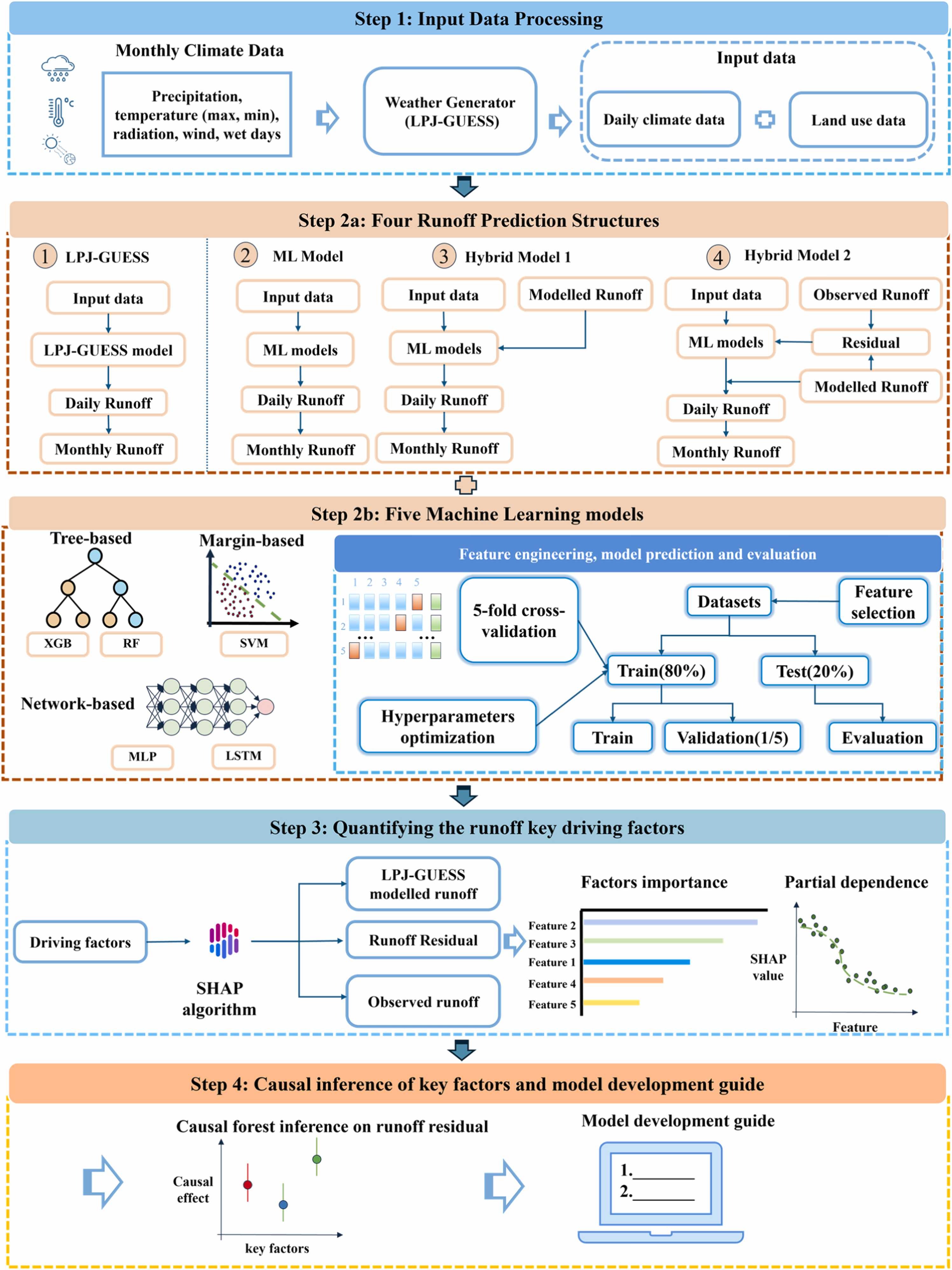
Runoff modelling workflow linking LPJ-GUESS, machine learning and causal inference. Zhou et al. (2026), Journal of Hydrology: Regional Studies, Figure 1. Copyright The Authors. Source / CC BY 4.0. Original figure; displayed at reduced size.
@article{zhou2026runoff,
  title = {{Optimizing runoff simulation in three mid-high latitude catchments by integrating terrestrial ecosystem modelling, hybrid machine learning, and causal inference}},
  author = {Zhou, H. and Tang, J. and Olin, S. and Guo, R. and Miller, P. A.},
  journal = {Journal of Hydrology: Regional Studies},
  year = {2026},
  volume = {63},
  pages = {103085},
  doi = {10.1016/j.ejrh.2025.103085}
}
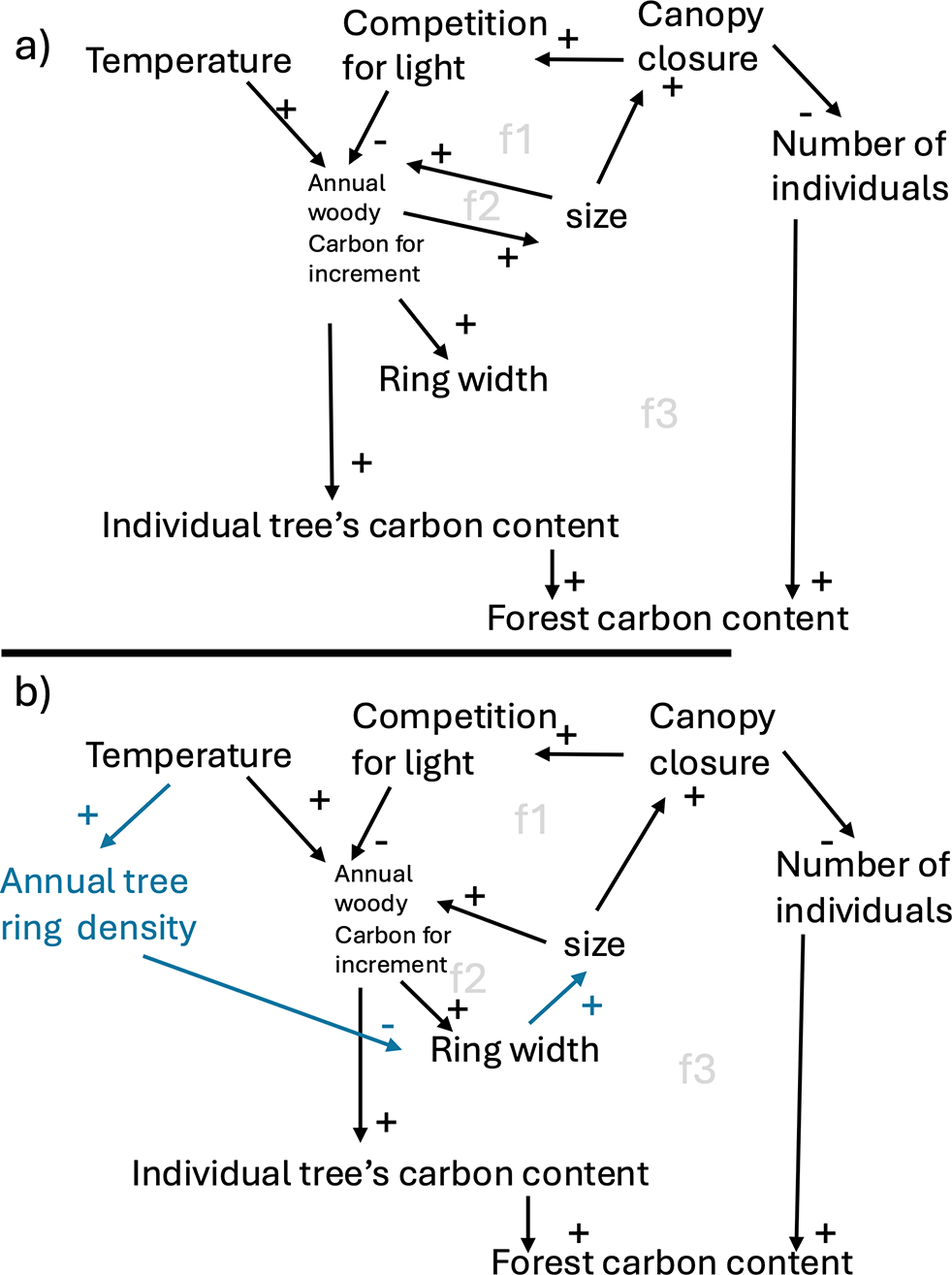
Process relationships in the standard and wood-density versions of LPJ-GUESS, for forest recovery without water limitation. Voss et al. (2026), Quantitative Plant Biology, Figure 1. Copyright 2026 The Authors. Source / CC BY 4.0. Original figure; displayed at reduced size.
Voss, A.-K.; Olin, S.; Zhou, H.; Fonti, P.; Eckes-Shephard, A. H.
Quantitative Plant Biology, 7, e5.
Abstract
Wood density (WD) is a crucial anatomical trait influencing forest carbon storage. However, dynamic global vegetation models (DGVMs) typically assume a fixed species-level WD, neglecting environment-driven variability. In this proof-of-concept study, we explore the potential impact of dynamic WD on tree- and forest-level carbon storage by integrating a simple temperature-response function of WD into the DGVM LPJ-GUESS from Smith et al., 2014.
Simulations along a temperature gradient show that incorporating environmentally responsive WD can substantially alter simulated stand structure and carbon stocks. Overall, our model experiments illustrated that sites with higher WD had more, but smaller trees, which stored less carbon compared to the standard model. The strongest effects were predicted to appear before canopy closure, where per-tree carbon deviated by up to 32%. This exploratory study suggests the need to represent a mechanism for dynamic WD to better assess ecological feedbacks to forest carbon storage predictions, particularly in young and regenerating forests.
Published abstract, Voss et al. (2026). Copyright The Authors. CC BY 4.0. Licence
@article{voss2026wood,
  title = {{Environmentally dependent wood density influences forest structure and dynamics in a demographic vegetation model}},
  author = {Voss, A.-K. and Olin, S. and Zhou, H. and Fonti, P. and Eckes-Shephard, A. H.},
  journal = {Quantitative Plant Biology},
  year = {2026},
  volume = {7},
  pages = {e5},
  doi = {10.1017/qpb.2026.10038}
}
@article{wang2025scenarios,
  title = {{Integrating Multi-Level Sustainability and Ecosystem Integrity for Adaptive Scenario Planning in China}},
  author = {Wang, Y. and He, Y. and Zhou, H. and Kuiper, J. J. and Scown, M. and Carpenter-Urquhart, L. R. and Olin, S. and Olsson, L. and Ye, Y. and Shen, S. and Fan, J. and Peterson, G. D.},
  journal = {Earth's Future},
  year = {2025},
  volume = {13},
  pages = {e2025EF006853},
  doi = {10.1029/2025EF006853}
}
The global water and carbon cycles are greatly influenced by terrestrial vegetation, making trustworthy representations of dynamic biosphere-hydrosphere interactions a crucial component of both ecosystem and climate models. This paper comprehensively evaluates the hydrological performance of a leading dynamic global vegetation model Lund-Potsdam-Jena General Ecosystem Simulator (LPJ-GUESS), using a broad range of the latest available global observation-based gridded datasets that cover the main components of the hydrological cycle. Overall, we find that the hydrological components modelled by LPJ-GUESS agree well with global gridded datasets of runoff, evapotranspiration and surface soil moisture, though there are discrepancies in some regions and periods. Furthermore, LPJ-GUESS accurately captures both inter- and intra-annual variations of runoff in most regions and catchment areas, including the Danube, Murray, Yangtze, Yenisei and Nile basins. Total evapotranspiration modelled by LPJ-GUESS agrees closely with the evapotranspiration estimates of the Global Land Evaporation Amsterdam Model and PML-V2 datasets, but with some disagreement in the individual components, especially for evaporation. The surface soil moisture simulated by LPJ-GUESS aligns with ESA-CCI (v5.3) surface soil moisture datasets in most regions, with greatest discrepancies in subarctic areas. We attribute these discrepancies to two main sources: (1) absent or poor representation of processes such as river routing, storage and supply of water bodies, and cropland irrigation; and (2) uncertainties in both reference datasets and input to the model, including precipitation, soil texture, and land use.
Published abstract, Zhou et al. (2024). Copyright The Authors. CC BY 4.0. Hyphen typography normalised for display. Licence
@article{zhou2024hydrology,
  title = {{A comprehensive evaluation of hydrological processes in a second-generation dynamic vegetation model}},
  author = {Zhou, H. and Tang, J. and Olin, S. and Miller, P. A.},
  journal = {Hydrological Processes},
  year = {2024},
  volume = {38},
  pages = {e15152},
  doi = {10.1002/hyp.15152}
}
@article{yun2024biomass,
  title = {{Changes in above- versus belowground biomass distribution in permafrost regions in response to climate warming}},
  author = {Yun, H. and Ciais, P. and Zhu, Q. and Chen, D. and Zohner, C. M. and Tang, J. and Qu, Y. and Zhou, H. and Schimel, J. and Zhu, P. and Shao, M. and Christensen, J. H. and Wu, Q. and Chen, A. and Elberling, B.},
  journal = {Proceedings of the National Academy of Sciences},
  year = {2024},
  volume = {121},
  pages = {e2314036121},
  doi = {10.1073/pnas.2314036121}
}
@article{niu2023steppe,
  title = {{Nitrogen addition and mowing had only weak interactive effects on macronutrients in plant-soil systems of a typical steppe in Inner Mongolia}},
  author = {Niu, G. and Wang, R. and Zhou, H. and Yang, J. and Lu, X. and Han, X. and Huang, J.},
  journal = {Journal of Environmental Management},
  year = {2023},
  volume = {347},
  pages = {119121},
  doi = {10.1016/j.jenvman.2023.119121}
}
@article{su2022tod,
  title = {{Unraveling the relative contribution of TOD structural factors to metro ridership: A novel localized modeling approach with implications on spatial planning}},
  author = {Su, S. and Zhao, C. and Zhou, H. and Li, B. and Kang, M.},
  journal = {Journal of Transport Geography},
  year = {2022},
  volume = {100},
  pages = {103308},
  doi = {10.1016/j.jtrangeo.2022.103308}
}
@article{zhou2019walkability,
  title = {{Social inequalities in neighborhood visual walkability: Using street view imagery and deep learning technologies to facilitate healthy city planning}},
  author = {Zhou, H. and He, S. and Cai, Y. and Wang, M. and Su, S.},
  journal = {Sustainable Cities and Society},
  year = {2019},
  volume = {50},
  pages = {101605},
  doi = {10.1016/j.scs.2019.101605}
}
@article{su2019walkability,
  title = {{Auditing street walkability and associated social inequalities for planning implications}},
  author = {Su, S. and Zhou, H. and Xu, M. and Ru, H. and Wang, W. and Weng, M.},
  journal = {Journal of Transport Geography},
  year = {2019},
  volume = {74},
  pages = {62-76},
  doi = {10.1016/j.jtrangeo.2018.11.003}
}
No publications match these filters. Try a different term or reset the filters.